Showing posts with label education. Show all posts

Friday, February 7, 2014

Homeschooling and College: My Experience


Leaders in the Homeschool Movement spend an exorbitant amount of time selling their rhetoric in words and in materials (books, videos, blog articles) sharing what they believe to be the ultimate role of women as homemaker: how to be respectful and submissive wives, how to cook, sew, how to raise children, etc.
If you are a young girl raised in this environment, your know your lot in life is: get married to your approved husband, have many children, teach your children at home, and hopefully, your children will do the same.
...The ultimate goal in the Homeschool Movement is to be fruitful and multiply and “take dominion” of the world. 
--"When Homeschooled Daughters are Trapped" by Julie Anne Smith, originally published on Spiritual Sounding Board

I remember the feeling of being trapped. I had been taught by Bill Gothard and Inge Cannon that college was both dangerous and unnecessary. I already knew it required a large investment of time and money, neither of which I believed I had. I had no job, and when I did get one much later, I was still dependent on my parents for transportation. In addition, I was always expected to help with both regular and irregular chores to keep the household and Dad's business running. Dad paid us to work for him, but the hours and the projects were subject to change according to what he needed. If he needed help, it wasn't presented as an optional job. Neither could I "turn down" a sewing project for Mom, even one she was offering to pay for.

Mary Pride, Vickie Farris, Elisabeth Elliot, and Nancy Campbell were certain my calling was to be a submissive wife and a full-time mother. Numerous writers were telling me that my dad should help select a future husband for me. But I was in my twenties now, and no young men were lining up for the privilege. I'd never even been asked out, never held hands with a boy, never talked to a guy my age on the phone. I was certainly raising babies, but they weren't mine.

At ATI conferences we would listen to "testimonies" of young adults who had left their college studies to return home and happily study the Bible with their younger siblings under the authority of their parents. We would expose ourselves to Satan's temptations if we left our parents' protection to live on a campus. We might even lose our faith. We would be corrupted by humanism and "vain philosophies". We might even succumb to "a dating spirit".


Besides, even without degrees we would have employers coming to us because of our excellent character, worth so much more than mere knowledge. Anything we needed to know, we could learn from masters through on-the-job apprenticeships. To a teenager whose primary outside contact was church on Sunday morning, it sounded so good in theory. I did some volunteer work, but no one came knocking in search of my great talents.

Years after I should have graduated from high school, Gothard's organization launched an alternative to college: a correspondence school by which one could study law from home. Loving the idea of having initials after my name, I was eager to apply to Oak Brook College of Law. But it turned out one had to have some college credits! Or, instead, they would accept a GED certificate and satisfactory CLEP scores in three subjects. So Dad got on the phone and made the arrangements. In January, I got my GED (at a facility for dropouts and delinquents) and sat for the necessary CLEP exams at the our community college.

In April 1995, the week before the Oklahoma City bombing, I spent a week at Gothard's Dallas Training Center doing "orientation". I remember being surprised that the young man picking me up at the airport was alone.(At nineteen years old, I'd never been alone in a vehicle with a single man before. Unspeakable things might happen!) The class was predominantly male, but there were a few other women. All the professors we met were male.

The dean, Roger Magnuson, kicked off the week by warning us of the spiritual perils of our course of study. He urged us to halt our studying if we sensed "our delight in spiritual things diminishing". I remember something about the school not being unaccredited "yet", but I had no idea what that meant. No one had ever explained regional accreditation to me, not even my dad who had a degree from Penn State. After all the introductions and preliminaries were over, I lugged my new books back to Michigan. For the next year and a half logged four hours of study a day, often falling asleep on my bed as I slogged through the heavy, sometimes bone-dry texts.

It was lonely as hell. I rarely got to converse with another student over the phone, and never talked to a professor. It would be two more years before we even got email access at home. I mailed in assignments, got grades back, and took my midterm and final exams at a proctor's house across town. Despite being a devout Catholic, she was an avid fan of Gothard ("He's the most Catholic man I know!") and did her best to spoil and encourage me when I came over. I was grateful to her, but it wasn't enough. All this time I continued to pull more than my weight helping around the house, tasked with keeping the bills paid, the dishes washed, diapers changed, the kitchen clean, and whatever else Mom needed me to do.

When my mother had a nervous breakdown two months after delivering her tenth baby, I was left in charge of the house, and meals, and seven younger siblings--for a week.  I kept assuring myself God would take care of everything, that he had things under control. But nothing was under control! And I was desperately trying to prepare for the state "Baby Bar" exam in San Francisco which would determine whether I could continue my studies or not.

When Mom returned home from a week discussing the Bible with a pastor in Indianapolis (the "counseling" she got at Gothard's training center), we all walked around on eggshells for weeks. There was The Knife incident. I was anxious and depressed and cried a lot in secret. I had trouble sleeping. I got sick. My appetite diminished. I felt like my whole life was in danger of crashing in pieces around me.

I feared Mom would fall apart again. I feared I would fail the exam and Dad's money, not to mention the last eighteen months of my life, would have been wasted. I feared turning into a steely woman lawyer in a boxy navy suit. I feared turning into a sexy female attorney in a fuchsia suit, wowing the judge with her perfume instead of her brains. I wished I had given up the notion of law school long ago!

I took the exam. Mom stabilized. While I waited for the test results, I sewed dresses for my little sisters and did a lot of thinking. My friends were starting to get married. In my terrible loneliness, rocking my infant sister, I longed for a man of my own, someone to embrace and love me. Was marriage in God's plan for me? Was I going to sew dresses for little girls of my own? Of what use would my studies be then?

I could not envision how a career in Constitutional Law could be compatible with marriage and homemaking. I had never actually met a female with a law degree. I had only observed them from a distance on visits to the county courthouse. It was understood in our circles that marriage meant choosing to be a homemaker.  Dad would never approve my marriage if he thought I intended to be a lousy wife!

By the time I heard that I'd passed the Baby Bar, I knew that I was done with Oak Brook College of Law. I did not have the emotional stamina to keep homeschooling myself through college for three more years! And even if I did finish, the school could not assure me that I would be qualified to practice law in any jurisdiction outside California. Since my home was in Michigan, and I had always lived with my parents, it was difficult to visualize a future forging a life for myself across the continent!

But I was soon sure I did not want to remain a stay-at-home daughter indefinitely. A year after taking the Baby Bar, I took the chance to work for Gothard's cult out-of-state. When that didn't work out and I found myself back home, I explored other options. I got an acceptable part-time job (I could wear modest skirts and the office manager agreed to keep the radio off on the days I worked) and started saving money--while still keeping up with chores and responsibilities at home. In a tentative act of independence, I applied for a temporary volunteer position with an evangelical missionary organization, telling them I was willing to go to Peru, Guatemala, or the Philippines.

And at age 24 I enrolled in a summer university linguistics program in North Dakota, taking real college courses for the very first time. Experiencing my first classroom (with real desks!) since first grade, I thrived! I reveled in the lectures, the labs, the camaraderie, the independent study, the collaboration with classmates, and the exams. Especially the exams. Like Anne of Green Gables, I loved the sweet taste of being at the head of a class instead of an isolated self-taught learner!

It would be another decade before I learned the difference between the ten "credits" I earned from Oak Brook College of Law and the ten credits I earned that summer from the University of North Dakota.

In the interim, a lot of life happened: marriage, babies, homeschooling. And eventually, enrolling in classes in community college. How strange to walk through those doors and sit elbow-to-elbow with kids nearly twenty years my junior. Every time I fill out a survey and select the "some college" option, I wonder, "What if I had spent my single adult years getting an education?"

As the oldest daughter, I was the guinea pig in many ways. Several of those now-grown baby sisters have sprinted past me in the race to an education. Yet, the last time I talked to my dad about the courses I was pursuing, his cool response was, "But I hope that being a wife and mother is still your main priority." It felt like a jab, a reminder that I was stepping outside the circle where I was supposed to stay and be happy. Perhaps he didn't mean it that way.

My children see Chris and I working on college assignments week after week and they can't help but see that we value learning. Because as it turns out, Gothard and his friends were wrong--outside their fantasy land, having or not having a traditional college degree can make a world of difference.


Wednesday, February 5, 2014

Genesis and Education


I went out by myself on Sunday afternoon. I left the rest of the family playing Minecraft in the basement and headed over to a repurposed old church building to see Wichita Community Theater perform Inherit the Wind.

According to Wikipedia, the playwrights had McCarthyism in their sights when they wrote this fictionalized version of the Scopes "Monkey" Trial in 1955. Perhaps so, but here in Kansas it is progressive science pitted against religious fundamentalism that still speaks volumes. I tucked my copy of Evolving in Monkey Town into my purse on my way out the door so I could brush up on the facts of the historical case while waiting for the show to start.
Darrow (left) and Bryan (right) at the Scopes Trial, 1925

Many years ago, my dad rented the 1960 film version of Inherit the Wind. Perhaps that was the month we studied transcripts from the Scopes Trial in our Wisdom Booklets. It was clear to us then that Clarence Darrow's character (Henry Drummond in the play) was the villain while William Jennings Bryan's character was the unfortunate champion of truth who mistakenly followed Ussher's notes in Scofield's Bible.

None of us had ever heard of Chromosome 2 back then. We'd never seen photos from Hubble. When we took field trips to zoos, or state parks, or museum exhibits depicting the glaciers that covered Michigan during the Ice Age, we were instructed to disregard signage referencing "millions" or "billions" of years. Those numbers were lies Satan wanted us to believe, the better to trick us into thinking we didn't need Jesus to keep us out of hell. Ken Ham was still my hero then, and we had a timeline (courtesy of ATI) mounted in our front hallway that placed Noah's Ark around 4000 BC. I used to study it while waiting my turn for the bathroom.

Anyway, I've always been fascinated by courtroom drama, and this play was magnificently performed. Sometimes a bit too magnificently for my comfort zone--between the mid-calf dresses, the references to the heat, the sucking-up mayor, the old-time religion, and a big "honorary colonel" keeling over with a heart attack, I felt like I was in Knoxville all over again.

But this was Dayton, Tennessee (excuse me, the play calls it Hillsboro) in 1925, not 1995, though I could swear that navy and white dress from the closing scene played a part in my personal history. And this time, I found my tension so often relieved by the sneers and smart-ass remarks of H.L. Mencken's godless character, I wanted to hug him, watch-chain and all!

Some of the lines delighted me all over again: "Do you think about the things you do think about?" Drummond's line of questioning about the sun standing still for Joshua made me wonder how my younger self had refuted the scientific evidence offered by the irreverent trial lawyer.

The director made a point to state his belief that science and faith need not be contradictory. And churches had taken ad space in the program, no doubt hoping to attract searching souls.

But in the end, I don't think the Scopes Trial, or Kitzmiller v. Dover Board of Education (2005), or Ken Ham's debate with Bill Nye last night is about religious faith at all. It's about whether one generation has the right to restrict children's education to what makes the previous generation comfortable. 

"The Fall of Man" by Lucas Cranach the Elder
Do our children have the right to keep up with the advance of human understanding? What if we our religious faith states that are things "God doesn't want us to learn"?

Where are the limits? Can a homeschooling family who believes in "white pride" isolate their children from exposure to racial integration? Or teach them that the Holocaust was a fraud? What if parents want to keep their children from learning multiplication tables? Or tell them they don't need to know how to read? What makes the study of the sciences unique in this debate?

We fucked, we made children. How much authority does that now give us to regulate what data enters their minds?  Is it fair, after all these years of scientific exploration, to fence our children off from certain branches of the Tree of Knowledge ?

What are we afraid of? Of losing their souls? Or of losing control of their minds?


Wednesday, December 18, 2013

Socialization and Boundaries


Have I mentioned how much I learn by observing my children?

We live too close to our kids' schools for them to ride the bus yet too far for them to walk alone, which makes for a lot of driving! But I have to admit, I cherish the minutes we get to share each afternoon as they tell me the things about their day that were the most significant to them. Often, they surprise me with what makes the top of their list.

I hear a lot of names: the friend they spent recess with, the friend they sat with at lunch, the friend who made them laugh in class, the friend they shared an inside joke with, the friend who got hurt, the friend who doesn't celebrate Christmas, the "best" friend, the friend who surprised them with a little gift.

When I was young, I lived for company. I was constantly begging my mom to invite other families to dinner. We socialized as families, only rarely as peer groups. So if I met a nice girl at church, the only way to get to know her better was to invite her parents and siblings to coordinate schedules in order to spend an evening at our house. What if her dad didn't get along with my dad? (In the end, all our friends came from other homeschooling families with stay-at-home moms who wore denim jumpers and breastfed their babies.) As I got older, I realized that guests meant extra housecleaning and extra work in the kitchen. It was still fun, but it was also a lot of work. By then, there were ten...eleven...twelve...thirteen of us. Our social invitations were limited to potlucks and graduation "open houses"!

When I married and moved to a new city where I knew no one but my in-laws, I was again desperate for company. I was always trying to gather people around my table: contacts from church, neighbors, extended family, old acquaintances with connections to Bill Gothard's cult. My husband, raised without siblings, could never quite understand my craving for social interaction, for sharing meals with other humans. It took years for me to realize that I was happier with a few quality friendships, even long-distance ones, than with frequent interactions with people I wasn't really compatible with.

With my kids in school forming so many new relationships, I braced myself for requests for guests, for playdates, for birthday parties, for outings with friends. When no one brought them up, I started asking. Maybe the kids had been too timid to ask. Were there any friends from school they would like to invite over sometime? To play with on a Saturday? To share their birthday cake?

No, it turns out, my kids just have better boundaries than I do. Each of them has plenty of friends at school. They enjoy their peers, look forward to seeing them, get along well with them, play at the activities that are available to them at school. But then my children come home and they enjoy each other, they play the games our family enjoys; they spend time playing alone, or reading, or watching their favorite shows. Sometimes they visit with friends in our neighborhood--friends they don't see at school. They rebuild connections here, then go out the next day and start again!

My siblings and I traveled as a pack when we went to a playground. "Public" spaces didn't mean "shared" so much as "available for temporary claims". We would keep our eyes on a piece of equipment, wait till all the other kids left it vacant, then swarm around our new territory. If another kid or two tried to engage with us, we would usually ignore them until they left, or until we tired and moved on to something else. When my family went
to the beach, we would pack up and head back to the car when other swimmers arrived.

My kids, especially the youngest, are much more comfortable in public spaces. They will engage with other children, play together, combine forces, join conversations. At the pool, the playground, or the gym, they are usually willing to accept other children as playmates. B--- will readily describe such a temporary attachment as "my new friend". Should a child not prove trustworthy, my children will distance themselves, recognizing instinctively that respect can be both earned and lost.

I applaud public education for helping my children learn boundaries. They are already more differentiated than I was at twice their age! They know where others end and they begin. They are neither isolated nor lonely. They are surrounded by opportunities to learn what matters to them: Shared values? Common interests? Compatible personalities? Similar or diverse customs? They get practical experience in cultivating relationships--what builds them and what damages them. They are learning which friends, or teachers, can be relied on, and which ones simply drain other people's energy.

Our entire family benefits from the social support that students provide to each other. At the beginning of this school year, our older two would build up a lot of anxiety and stress each day. It took a lot of my energy to coach them and reassure them. But as the year goes on, they are building stronger bonds with their classmates. They endure the same pressures, but they don't feel alone. By the time they get home these days, the kids have worked through most of their stresses. They have already laughed with a friend about the grumpy substitute or shared a complaint about being treated unfairly at recess. I bring them back to the house and they are ready to move on to happier things.

I can't help wondering how my life would be different if I had not been such a lonely child. What if church services and Vacation Bible School had not been my only contacts with peers? What if I had been surrounded with boys and girls my own age whose life experience was different from my own?

I learn so much from watching my children be human.


Friday, October 18, 2013

Science Controversies in Kansas


When a friend and I took our kids to the Dinosaurs Unearthed exhibit at Wichita's Exploration Place this summer, we were startled by this notice at the main entrance to the exhibit.


Considering that Wichita's Sedgwick County Zoo, the most popular tourist attraction in the state of Kansas, prides itself on not presenting visitors with any references to evolution, I shouldn't have been surprised. This zoo, 18th largest in the nation and sponsored by numerous corporation and local businesses, offers numerous educational programs. Their parking lot is often filled with school buses, and the zoo reimburses Title 1 schools for transportation costs. They also cater to homeschoolers, offering special presentations, discounted admission days, and educational resources available for nominal rental fees. As a homeschooling mom at one of these events, I was impressed at how well the zoo staff knew their audience: the presenter volunteered that the zoo is careful to avoid any mention of evolution or long time frames in any of their educational materials.  

By contrast, Botanica, Wichita's botanical gardens, quietly displays a subtle statement outside the butterfly garden. When I first visited the gardens as a young earth creationist, I noticed the little sign and it made me slightly uncomfortable, as if I'd encountered a thorn in the midst of Eden.

The Beil limestone at the base of the sign.

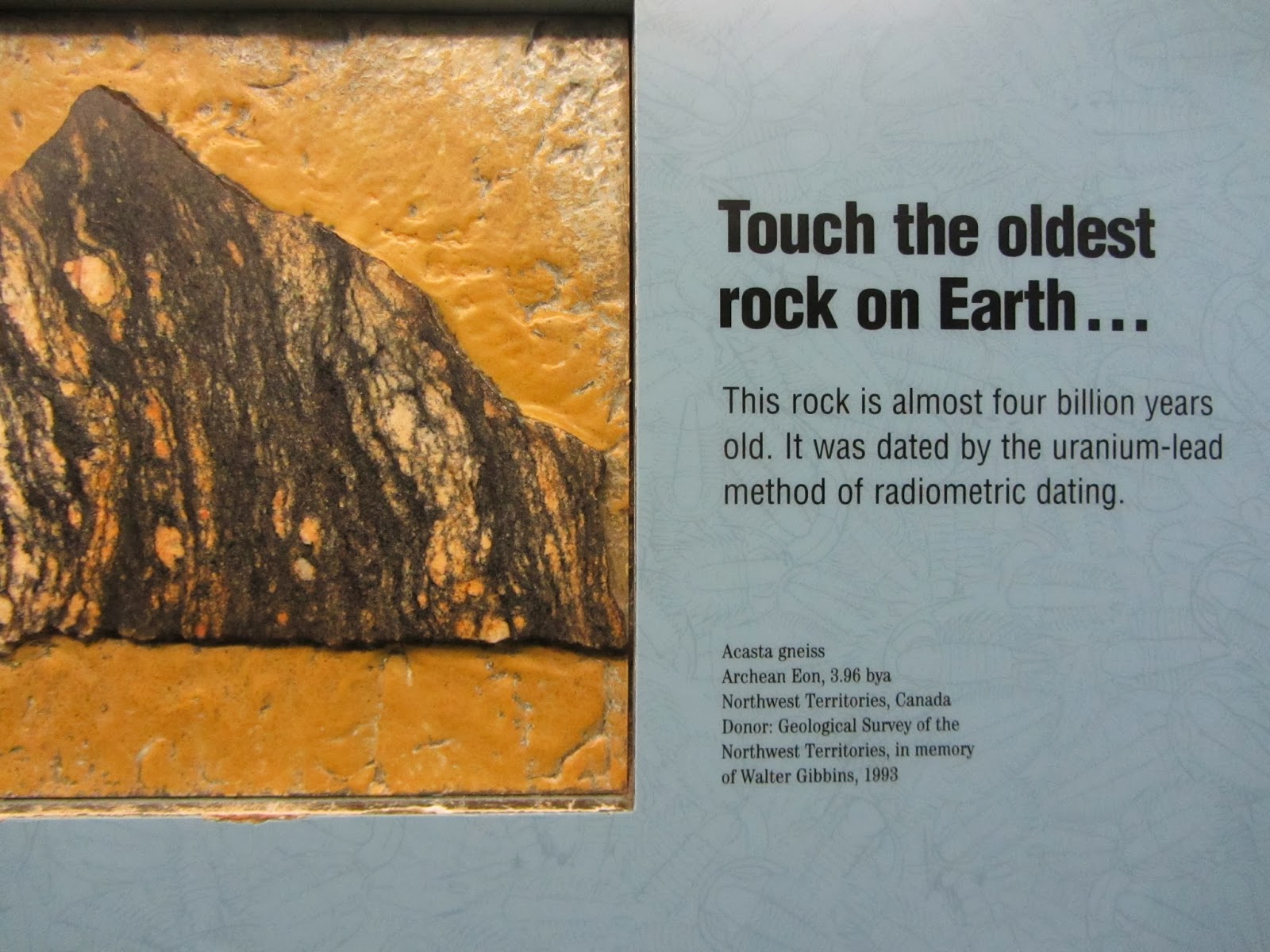
This month, we visited the Denver area. We spent a day at the Denver Museum of Nature & Science, touched ancient fossils and dinosaur footprints at Dinosaur Ridge, and learned more about dating rocks at the Colorado School of Mines Geology Museum. The exhibits were all so matter-of-fact about simply presenting the evidence. No one was walking on eggshells or trying to skirt the issue of evolution.


Today, back in Kansas, there is fresh controversy over science standards. According to Kansas.com,
"The State Board of Education is asking Kansas Attorney General Derek Schmidt to defend it in a lawsuit over its decision to adopt new science standards. Board members met with their attorney in executive session this week about the federal lawsuit filed last month by an anti-evolution group called Citizens for Objective Public Education.
. . .
"The lawsuit names the board and individual members as defendants. It contends the new science standards promote atheism and violate the religious rights of students and parents.
"The standards were developed by Kansas, 25 other states and the National Research Council. They treat evolution and climate change as key scientific concepts to be taught from kindergarten through 12th grade.
These Next Generation Science Standards state that "science is a way of explaining the natural world." They go on to explain: "Indeed, the only consistent characteristic of scientific knowledge across the disciplines is that scientific knowledge itself is open to revision in light of new evidence."

But revision in light of of new evidence makes many people uneasy, so the controversy over how to educate our children will go on. My daughter's middle school teacher offered a disclaimer in case the video she showed on "origins" should conflict with what any student's traditions or beliefs. 

This sign, along a walking trail at the Wichita's Great Plains Nature Center, illustrates just how controversial the subject of geologic time continues to be in Kansas, and how strongly it stirs people's emotions. 

This interpretive sign was vandalized by a zealous visitor.

Saturday, September 28, 2013

Character First and Bill Gothard


Truthfulness: Earning future trust by accurately reporting past facts


The Character First program has silently glided into numerous places where Gothard's other materials would undoubtedly raise alarm: public school districts, city government, state government agencies, law enforcement, and prison systems. When journalists or concerned citizens have challenged adoption of the Character First materials--by their local schools, for example--Character First has been quick to deny association with religious extremist Bill Gothard or his Institute in Basic Life Principles (IBLP).

I believe the official statements are deceptive. Yes, Character First is no longer financially connected to the IBLP organization. However, its links to Gothard's Institute are undeniable. This post will describe Gothard's original character program and trace its evolution into what is now the Character First curriculum.

Gothard's Character Quality Chart

49 Character Qualities

According to one of his many websites, "Bill Gothard is the founder and president of the Institute in Basic Life Principles, which is a non-profit corporation established for the purpose of introducing people to the Lord Jesus Christ. He is dedicated to giving clear instruction and training on how to find success by following God’s principles found in Scripture." Theologically, the Institute promotes many Christian fundamentalist beliefs. IBLP posts its corporate statement of faith on its website, including assertions that "hell is a place of eternal conscious punishment for... all unbelievers" and that Adam "did not evolve from preexisting forms of life".

My parents attended Gothard's Basic Seminar in Houston in late 1979 or early 1980. They were enthusiastic about applying the content. After they attended an Advanced Seminar, I remember them showing us illustrations from the textbook giving us a quiz to help determine what our "motivational gifts" were. Gothard's teaching on spiritual gifts (influenced by Bob Mumford, John Rea, and Arnold Bittlinger, among others) amounted to a kind of personality test. There were seven possible labels, corresponding to descriptive terms used by St. Paul in the twelfth chapter of Romans.

Gothard has always loved the number seven (also God's favorite number, according to him--with twelve and forty following in order of divine preference). Seven is supposedly the number of completion, of perfection. So there are seven "gifts" or motivations, each with their own characteristics, strengths and weaknesses. In a perfect world, everyone uses their gifts for the good of everyone else. So far so good.

But spiritual "gifts", which made up a large part of the vocabulary used by IBLP insiders, were only one of the towers of the IBLP edifice. They rested on the wider base of the 49 Character Qualities. Gothard wrote "operational definitions" for these qualities, and assigned seven to each motivational gift as its unique values or strengths. I am unable to determine which Gothard came up with first, the seven gift types or the forty-nine character qualities, but he combined them very early on, settling on the final definitions sometime after 1976. Each quality is contrasted with its opposite, a negative character trait which must be overcome.


The Gift of Teaching
  • Dependability vs. Inconsistency
  • Diligence vs. Slothfulness
  • Patience vs. Restlessness
  • Reverence vs. Disrespect
  • Security vs. Anxiety
  • Self-Control vs. Self-Indulgence
  • Thoroughness vs. Incompleteness

The Gift of Exhorting (encouraging personal development)
  • Creativity vs. Underachievement
  • Discernment vs. Judgment
  • Discretion vs. Simplemindedness
  • Enthusiasm vs. Apathy
  • Faith vs. Presumption
  • Love vs. Selfishness
  • Wisdom vs. Natural Inclinations

The Gift of Giving
  • Cautiousness vs. Rashness
  • Contentment vs. Covetousness
  • Gratefulness vs. Unthankfulness
  • Generosity vs. Stinginess
  • Punctuality vs. Tardiness
  • Resourcefulness vs. Wastefulness
  • Thriftiness vs. Extravagance
  • Tolerance vs. Prejudice

The Gift of Organizing (administration)
  • Decisiveness vs. Double-Mindedness
  • Determination vs. Faintheartedness
  • Humility vs. Pride
  • Initiative vs. Unresponsiveness
  • Loyalty vs. Unfaithfulness
  • Orderliness vs. Disorganization
  • Responsibility vs. Unreliability

The Gift of Serving
  • Alertness vs. Unawareness
  • Availability vs. Self-Centeredness
  • Endurance vs. Giving Up
  • Flexibility vs. Resistance
  • Generosity vs. Stinginess
  • Hospitality vs. Loneliness
  • Joyfulness vs. Self-Pity
  • Endurance vs. Giving Up

The Gift of Prophecy (speaking warnings about sin)
  • Boldness vs. Fearfulness
  • Forgiveness vs. Rejection
  • Obedience vs. Willfulness
  • Persuasiveness vs. Contentiousness
  • Thoroughness vs. Incompleteness
  • Truthfulness vs. Deception
  • Virtue vs. Impurity

The Gift of Mercy
  • Attentiveness vs. Unconcern
  • Compassion vs. Indifference
  • Deference vs. Rudeness
  • Gentleness vs. Harshness
  • Justice vs. Fairness
  • Meekness vs. Anger
  • Sensitivity vs. Callousness

Along with the seven "universal, non-optional life principles", these forty-nine character qualities form the central core of Gothard's teaching because of his belief that "one of God’s primary goals for believers is to transform them into the image of His Son so that they may be a reflection of the character of Christ." Gothard teaches that these qualities express God's character and that we become more Christ-like as we train ourselves and each other to demonstrate these characteristics. "Life will take on a whole new meaning as you begin to understand the importance of character and see the lasting rewards of a life that exhibits the character of God." (IBLP website)


Character Clues

Character Clues Game
For decades, Gothard's Institute sold a game called Character Clues. It consisted of a stack of laminated cards, each with the name of a character quality in different decorative fonts. The other stack contained Gothard's definitions. Each card also had a code in the upper corner, to distinguish which "spiritual gift set" it belonged to, as shown in this chart.

Playing Character Clues was a two-step affair. For the first few minutes, we would frantically swap cards with other players, trying to collect one complete set of seven. The rest of the "game" was to memorize the definitions and be the first to call out the quality as the definition was read aloud. We used to play it at home, and later on Game Nights with the staff at the IBLP training center on Main St. in Oklahoma City. It was impossible to play with friends outside the Gothard cult, as we could spit out the definitions in seconds and anyone else would be lost trying to understand how we could jump to "Obedience!" from "Freedom to be creative...".

Character Sketches

Another of Gothard's character projects were the Character Sketches nature series. He originally envisioned seven volumes, but the project ran out of steam after only three (published in 1976, 1978, and 1985). Each handsomely-bound and beautifully-illustrated volume presented nature stories in which the featured species demonstrated an aspect of the highlighted character quality. The story was followed by a biological sketch of the animal habits, and then by an interpretation of a some Bible story in which the character demonstrated either the quality or its opposite. Gothard's younger brother Steve was heavily involved in the creation of these books in the 1970's.

ALERT, another of IBLP's spin-off programs, is a year-long character-building course for "Christian young men" that kicks off with military-style basic training in Big Sandy, Texas. ALERT also sells the Character Sketches series and lists their author as Larry Guthrie.

Dr. Larry Fields Guthrie earned his Ph.D. at the University of Illinois in 1971. Before becoming an Associate Professor of Education at Indiana University Northwest, he taught high school science for seven years. After the university fired him in the late 1970's, he found employment at Gothard's Institute as a staff writer and research assistant for twenty years. A natural storyteller, Guthrie likes to spin the termination of his employment positively, saying that he had recently given his heart to Jesus and willingly gave up academia to serve Christ elsewhere.

Dr. Larry Guthrie
According to IBLP's Embassy Institute: "One day, while teaching at Indiana State University, Dr. Larry Guthrie was informed that his book publishing record was insufficient and they had to terminate his teaching. However, God had given Larry a keen understanding of the world of nature and a remarkable ability to capture the attention of audiences as he explains life principles from the world of nature. Larry wrote the nature sections of the Eagle Story, Character Sketches Series, and other books." However, since Guthrie's appointment at Indiana University continued until May of 1979, it is unlikely he authored any part of the first two Character Sketches. Other sources indicate he wrote for Volume III of the series, and also for Volume IV, which was never completed.

In addition to whatever nature studies he penned for Character Sketches, Guthrie "also wrote science and medical curriculum materials for the Institute's home education program, the Advanced Training Institute of America. Dr. Guthrie is the former director of the Children's Institute which offers character training and instruction in basic Biblical principles to children ages 6-12. Over the past 10 years, these week-long children's seminars have enrolled over 175,000 children in 50 cities and eight foreign countries. Dr. Guthrie also served as Director of Curriculum Development for Character First! Education, a national non-profit character training program for public schools with headquarters in Oklahoma City." Described in 2010 as a "vital part of the IBLP ministry for many years", Guthrie is still a popular keynote speaker for regional homeschool conferences, presenting lessons about obedience to parents, attentiveness to instructions, and escaping the temptations of Satan.

In 2009, Guthrie became the chairman of the board for IBLP's Verity Institute:
"Verity Institute exists to develop leaders who love Jesus Christ and the Word of God. Established in 2001, Verity Institute was founded to disciple college students to be faithful followers of Jesus Christ as they pursue higher education. Verity helps students avoid the pitfalls of traditional college campuses such as non-Christian professors, secular humanism, and loose campus morals. In our innovative, 21-month program, Verity students complete a Bachelor of Arts or Science degree through an outside, fully-accredited university at a fraction of traditional costs for higher education."

Character Booklets and Children's Institutes

In 1991, Bill Gothard made connections with the Russian government that resulted in a partnership with the Department of Education in Moscow. In 1992, the Institute hosted an official delegation from Russia, including a young Boris Yeltsin, grandson of the Russian president, at its headquarters outside Chicago and at Gothard's retreat center in northern Michigan. In 1993, I was one of the homeschooled Advanced Training Institute (ATI) students invited to represent the Institute in Moscow's public schools, private schools, and orphanages. I was seventeen and it was my first experience outside the U.S.

Strict IBLP rules applied within our group: there was to be nothing even resembling dating, no music with a rock beat, no foolishness or loitering, no chewing gum. Males wore ties for most activities; females had to wear dresses, skirts, or loose culottes. On Sundays, we fasted from food until supper. As a student enrolled in Gothard's homeschooling program, these rules were quite familiar to me and did not seem burdensome. In our training meetings at the outset of the trip, we were urged to "clear our consciences" for our own protection, not holding any secrets from our parents. I dutifully wrote a letter home confessing to my parents that I had masturbated when I was younger. Dad faxed back a reply: "We forgive you!"

Our team was directed by George Mattix, now Director of IBLP's International Department. On our way to board the Aeroflot jet, we were handed brand-new booklets defining the character qualities we were about to teach and offering suggestions for activities. Each week we presented lessons in "character" to Russian schoolchildren, using illustrations like the inner workings of an ear, or Abraham Lincoln's honesty, or even the seven days of creation from Genesis. We invited the teachers and older students to evangelistic meetings with hymns, skits, and personal testimonials about how well biblical principles work.

We also helped put on Gothard's Basic Seminar at a cavernous Moscow stadium. To make attendance as convenient as possible, we served sack lunches and improvised special activities for children. This very first "Children's Institute" was deemed such a success that Gothard announced a similar conference for children during the summer ATI training seminar in Knoxville that year.

Soon Children's Institutes, under the direction of Dr. Larry Guthrie as noted above, were being held in conjunction with IBLP Basic Seminars around the country and internationally. At the one I participated in with Dr. Guthrie in Detroit in 1994, we taught the children that Satan could gain access to plots of "ground" in their souls if they were not obedient. Clearly, the Children's Institutes taught more than just the character curriculum, but since many of us had already been trained to teach those first character qualities and the activities were already packaged, the children always got a heavy dose of Attentiveness, Gratefulness, and Obedience.

Gothard himself later attributed the Character First Education curriculum to the earlier program used in Moscow.
"I originally created the materials for the program in 1991, for Russia," explained Gothard. "After I presented a seminar on Basic Life Principles in Russia, President Boris Yeltsin contacted me and asked if I would create a character program for Russia's public schools. So I created a program for them, which they still use."**
"I revised the materials we did for Russia, and they tried them out in eight Oklahoma City schools," said Gothard. "By 1998, 33 Oklahoma City schools used the program and in 1999, 50 use it. Across the nation, over 700 schools in 40 states are using Character First!"
(Source: "Staying In Character: Program Helps Promote Admirable Qualities"
Chicago Tribune; April 23, 2000)

Gothard advertised his new "universal" character materials to pastors, homeschooling families, community leaders, international contacts, and anyone else who would listen. "Character explains why things happen to us," he taught. God is continually working to mold our character into perfection ("to conform us to Christ"). Recognizing people for their achievements only breeds competition and conflict. The better way to motivate people to do good is to praise them for displaying good character instead.


**After falling out of favor with Moscow's Dept. of Education, due in part to their abusive discipline of Russian orphans, IBLP was pressured to abandon the Russia ministry. But hundreds of IBLP followers, including Texas Republican kingmaker James Leininger and his wife and daughters, got to cut their teeth on character education there.

Character Training Institute

Character First would dispute Gothard's claim to have created the program. Six Character Booklets were eventually marketed to IBLP seminar attendees and ATI families, but before another set could be completed there was something new growing on the horizon.

Thomas Hill
Tom Hill, an Oklahoma City businessman who was not only a longtime supporter of the seminars and a personal friend of Gothard but was also serving as chairman of the Institute's Board of Directors, launched the Character Training Institute (CTI). In 1992, Hill took Gothard's 49 character quality definitions and sanitized them for secular use at his company. In most cases, removing the religious component from the definitions required only some deft excision. The result was simply an ambitious self-improvement program. Hill saw potential in selling this character training package to other corporations and non-profit organizations--including government offices.

What employer wouldn't want to emphasize to their employees the importance of Availability ("Making my schedule and priorities secondary to the wishes of those I serve") and Thriftiness ("Allowing myself and others to spend only what is necessary"), or want their staff to exercise Self-Control ("Rejecting wrong desires and doing what is right")? Subscribers to the Character Bulletins got a fresh character quality sheet each month with stories and motivational tips.

The CTI office was run  from the Oklahoma Training Center, owned by Hill's Kimray Inc. and provided to IBLP as a base for multiple programs. Character First Education was also stationed at the center and operated by IBLP/ATI staff families and students. Technically two separate offices, there was a lot of overlap between the two Character Firsts. Many Character First materials were prepared by homeschooled students selected from Gothard's Advanced Training Institute.

The center in Oklahoma City began offering week-long training for "Character Coaches". Teens and adults could become certified to pitch and/or teach the Character First program in their own communities, carrying it back to their local churches or school districts. In July of 1997, my dad took the whole family to Oklahoma City so four of us could take the course with him. I was in my early twenties and had zero interest in being there, but as a "stay-at-home daughter" I believed Dad was my "authority" and the trip was mandatory. As consolation, I tried to convince myself that God was somehow going to use the rather unpleasant week towards my perfection. 

Dr. Joseph Ahne is a certified CTI trainer. At a training center conference in 2005, he had this to say:
“They don’t tell you this here, but it’s all biblically based,” Dr. Ahne says. “They use the animals to illustrate the points that are all from the Bible. You see, it’s about becoming like Christ. Through teaching the character, we’re teaching people how to be like Christ. We could all use that.”

“We use this,” he says, pointing to the Character First binder in the middle of the table, “because we can’t take religion into schools and government. But it’s all based on the same thing.”

Character First Education

Character First Education launched its pilot project in February, 1997 in Oklahoma City. Teams of homeschooled teenagers (recruited from Gothard's ATI program) would be brought to the Oklahoma Training Center at 520 W. Main Street, provided to IBLP by Kimray Inc., to spend months at a time teaching the new Character First curriculum in the public schools under the direction of Kent Fahrenbruck. These "Character Coaches" paid for their training and for their room & board while they were at the center. For many of them, Character First was their first experience entering a public school. They were expected to be at morning Bible study before school and to help with chores around the training center after dinner (usually housekeeping or kitchen cleanup). And the strict IBLP dress code applied: no blue jeans, and women could not wear slacks of any kind.

Robert Greenlaw
Robert Greenlaw's family was enrolled in Gothard's ATI homeschooling program. Robert attended his first "life principles" seminar before he was 14, learned about the natural tendencies of his "spiritual gift" at the Advanced seminar, spent time at IBLP's Moscow Training Center, and led Children's Institutes at Gothard's seminars. In 1996, he helped develop the Character First Education program. Today, Greenlaw manages all Character First publications and training development.***

Many Character First Education materials and artwork were simply borrowed from other IBLP programs, especially from the Children's Institute curriculum developed by ATI students and staff to teach children the seven "life principles" Gothard claimed to discover in the Bible. For example, the Attentiveness song from the Character First Education program is identical to the Attentiveness song taught at Children's Institutes:
"When there's someone else who's saying something that I need to hear,
If I'm easily distracted, it will not be very clear.
I must listen very closely to the things they have to say;
I will choose to be attentive ev'ry hour, of ev'ry day!
"I'll be attentive, so very attentive!
I will show the worth of what they have to say!
And when I am tempted to not be attentive,
I will choose to be attentive anyway!"


The Oklahoma Training Center became a veritable labyrinth of different jurisdictions with varying expectations, codes of conduct, and dress codes. My roommate was an intern for the CTI, other friends were there as volunteer teachers for Character First Education, some teens were sent by their parents for character-building "life experience" training (usually kitchen or maintenance jobs), a team of young adults had an outreach project to at-risk kids in local shelters, and I was working (as a volunteer for six months, and then as a minimum-wage employee) for the IBLP Chicago office from my desk in Oklahoma City. Whether or not we personally endorsed Character First (I sometimes referred to it as Karachterfurst), we were all expected to support the character effort. I helped package many more Character Cards than I cared to count in the training center dining room after work. Despite my misgivings about the CTI, I enjoyed the bustle of helping with Character Bulletin mailing projects because the flurry and rhythm reminded me of my previous volunteer work for political campaigns.

During my year at the Oklahoma Training Center, no staff women were permitted to wear jeans or slacks, all families residing at the center homeschooled their children, student volunteers were expected to fast on Sunday, kitchen workers were harassed for using white flour, and playing "contemporary" worship songs like "As the Deer" on the grand piano was frowned upon. We had a group Bible study before breakfast, corporate prayer time before lunch, and Gothard's Basic Seminar was shown on video some evenings.


***Ken Pierpont, another personal friend of Bill Gothard, describes Robert Greenlaw as "an absolute poster-child for IBLP. Mr. Gothard should be proud of guys like this."


Character First for Law Enforcement, Prisons, and Cities

Ray Nash for Congress
The Character First program has infiltrated city governments and law enforcement across the country. By 2006, 160 cities had passed "character resolutions", adopting CTI programs or materials. Ray Nash, former sheriff of Dorchester County, South Carolina is also a Character Training Institute instructor:
Nash has conducted "Police Dynamics" training for numerous U.S. and international police departments. "Really, what Police Dynamics is, in a nutshell, is biblical wisdom that’s been packaged into a law enforcement message," Nash told Rev. Mark Creech in a November 2004 article for Alan Keyes’ RenewAmerica Web site.  (Cult of Character)
Through Police Dynamics, Nash says he has trained over 10,000 government and business leaders from dozens of countries. Nash retired from law enforcement following a scandal in 2008. He went on to serve as Criminal Justice Adviser for the US Embassy in Kabul. He has a private investigation company and ran for a seat in Congress earlier this year.

Character First's prison curriculum, which contains stories from the New Testament and numerous teachings from Gothard's Basic Seminar, was developed in cooperation with the Oklahoma Department of Corrections. According to an investigative report by Silja Talvi in 2006, in Oklahoma City,
"...even the local county jail’s elevators feature Character First posters in Plexiglass displays, and juvenile detainees study character concepts with the jail chaplains. Each employee receives a Character Bulletin with his or her paycheck, explains Chaplain Argyle Dick. “We hire for character, and we fire, most of the time, for lack of character. … We are always looking for new ways to saturate even more of our employees with character.”
The Character Council of Central Oklahoma has even entered into a “covenant” with the regional career tech programs, covering 12 campuses. “That’s our plan for getting character qualities into the hearts and minds of all students,” explains Dr. Earlene Smith, the Education Committee chairman for the council.
The Arkansas Dept. of Corrections uses Character First with its employees. Inside Arkansas prisons, a revision of the Character First program has become the more religious "Principles and Applications for Life", also led by "character coaches". Ohio added Character First to their offender education curriculum. The city of Conway, South Carolina has Gothard's 49 Character Qualities posted on its municipal website.  A news article earlier this month featured a photograph of Oklahoma Insurance Commissioner Doak speaking in front of a CharacterFirst poster.

Lisa Sorg reported in 2006 for the Texas Observer,
“Burleson heralded as city of character,” boasted the headline in the April 28, 1999, edition of the Burleson Star, the town’s newspaper. The City Council, school board, Chamber of Commerce, and Ministerial Alliance Auxiliary had signed a resolution making Burleson a City of Character. “I do think it’s a religious deal, and I’m not afraid to say it,” Jeff Turner, then-superintendent of the Burleson school district, was quoted as saying.


Sorg's article goes on to observe:
"Obedience figures largely in the Character materials. In the book, How to Build Character as a Family, obedience is mentioned no less than 10 times in a 68-page discussion of character traits, and is described as a protective force. Security: 'I will look to my authorities for protection.' Flexibility: 'I will respect the decisions of my authorities.' Honor: 'I will obey cheerfully.' Justice: 'I will respect the authority of the law.' Loyalty: 'I will not mock authorities.' Obedience: 'I will obey my authorities immediately.' Enthusiasm: 'Not only does enthusiasm brighten the face and give light to the eyes, but it also acts as a natural medicine that builds strong and thick bones.'
"Each character trait also has an opposite. The opposite of obedience is willfulness..."


Why Character?


According to Gothard's website:

  1. Every quality personifies Christ. Jesus Christ is the full expression of every positive character quality. He is truth, love, forgiveness, gentleness, generosity, patience, kindness, and every other quality.
  2. Character explains why things happen. God promises that all things work together for good to those who love God, because they conform us to the image of Christ. (See Romans 8:28–29) If we are lacking in a particular character quality, God will often allow circumstances and even tragedies to develop that quality in us. David said, “It is good for me that I have been afflicted; that I might learn thy statutes” (Psalm 119:71.)
  3. Qualities are needed to praise others. We are commanded to encourage and exhort one another on a regular basis. One of the most effective ways to do this is to recognize positive qualities exhibited in the life of another and praise him for it. In order to do this, we must be able to identify specific character qualities and give their definitions.
The emphasis on Gothard's 49 character qualities made the IBLP environment incredibly toxic. We were "saturated with character" and we could never live up to the impossible standard of perfection held in front of us. We were encouraged to overwork ourselves to please our authorities and win praise for diligence and endurance. We were constantly on guard against temptations to choose "foolishness", "extravagance", or "slothfulness". Not surprisingly, many former ATI students are now in therapy for deep anxiety issues and stress-induced health problems.

Additionally, as numerous former Gothard followers have discovered, developing character traits like meekness and obedience can set individuals up for abuse. Gothard has long been criticized for counseling victims to give up their personal rights, to remain in abusive relationships, and to look for how their own poor choices (lack of character) could have caused the abuse. He is also known for habitually blaming victims of sexual violence. The secularized Character First approach does little to correct that imbalance in favor of abusers.


FORGIVENESS: 
"Clearing the record of those who have wronged me and not holding a grudge."

FAITH: 
"Confidence that actions rooted in good character will yield the best outcome, even when I cannot see how"

TOLERANCE: 
"Accepting others at different levels of maturity"


Today, I still wince when I drive past a public school sign announcing the character quality of the month--unless it happens to be "RESPECT", a virtue Gothard failed to recognize. To its credit, Character First has replaced Gothard's subservient Reverence with Honor, which it now defines as "Respecting others because of their worth as human beings". The sentimental Love has become the more office-appropriate Benevolence, and the antithesis of Justice is now "Corruption" rather than "Fairness".

Though Gothard may believe perfect character is an exact representation of God, Character First, now owned by Strata Leadership LLC which counts the U.S. Food & Drug Administration, the Virginia Department of Social Services, and Hobby Lobby among its clients, is less committed to the original 49 qualities. Good character is not set in stone, after all, and society's values need room to evolve. The Character First website states"We reserve the right to change qualities and definitions as needed..." 

I praise the CTI team for this display of a trait long demanded of Bill Gothard's supporters: the character quality of flexibility.


READ MORE about Bill Gothard's political connections, his educational philosophy, and about growing up as an ATI student.

Tuesday, September 10, 2013

David Barton: Homespun History


History was my favorite subject as a kid.

I devoured the Little House on the Prairie series, was enchanted by Ben and Me, and giggled through Jean Fritz's junior biographies of King George III, Samuel Adams, and Patrick Henry. I would slip away into "the study" to read and re-read the fourth grade A Beka textbook on the American colonists, the lives of the presidents in our 1968 World Book, or tales of Marco Polo and Christopher Columbus.

Later, our bookshelves bulged with biographies of Lincoln, Anabaptist stories of the Reformation, and thick volumes from Bob Jones University Press skimming across the centuries from ancient Greece to World War II. Once, Dad brought me home a copy of Kennedy's Profiles in Courage. And I could recite most of the dialogue from "A More Perfect Union", Brigham Young University's dramatic film about the Constitutional Convention.

When Bill Gothard first distributed David Barton "America's Godly Heritage" to homeschooling families in his Advanced Training Institute, I was entranced. We listened to that first cassette together and marveled at Barton's rapid-fire diction. After that, I would follow along with the tapes with my notebook and pencil and try desperately to copy out the quotations from the Founders as Barton galloped from one to the next at rodeo speed. Protected as I was from secular influences and celebrity worship, Barton was the equivalent of a rock star in my world. I collected Barton's numerous books and a stack of cassettes. I copied out and memorized my favorite lines. When he addressed the national ATI conferences in Tennessee, I was giddy with excitement. I wished the audience would quit applauding so he could fit in more of his speech!

Besides Barton's books on American history, I even purchased his obscure 31-page booklet How to Have Success With God, published in 1984:
"To God, obedience is better than anything."
"The more you do of what you hear from God, the more you will hear from God what to do!"
"Be a Christian who enjoys obeying God and you will enjoy being a Christian!"
Today, "David Barton is a former Vice Chairman of the Republican Party of Texas and a political consultant for the Republican National Committee. He is also a bestselling author and political activist who has worked diligently to arouse true patriotism and restore America to her Biblical foundation."
But back then, Barton and his organization Wallbuilders had not yet gained notoriety outside Texas. In time he would get chummy with Sen. Sam Brownback of Kansas, U.S. Rep. Todd Akin of Missouri, and the chairman of Gothard's Board of Directors, Congressman Sam Johnson of Texas. Brownback would say of Barton, "His research provides the philosophical underpinning for a lot of the Republican effort in the country today -- bringing God back into the public square." And that was a mission I supported wholeheartedly.

When my worldview began to unravel, however, I revisited the Wallbuilders' website, curious for answers that would settle some of my doubts. For the first time I realized that David Barton has no credentials as an historian or an archivist. He holds a B.A. in religious education from Oral Roberts University and has been both a [math and science] teacher and a principal at a private Christian school in his hometown of Aledo, Texas.

As a homeschooled student myself with limited exposure to the ways of academia, I could sympathize with Barton's ignorance of correct protocol for citing sources. But I was flummoxed to learn that he lacks primary sources for some of his quotations. Including some of my favorite quotations--lines I used to recite glibly at candidates who brought up the spurious "separation of church and state". Now this was unsettling. 

I hadn't heard David Barton for well over a decade when he appeared as a guest on "The Daily Show with Jon Stewart". Well, here was a blast from my past! I settled in to listen to the Texan's familiar too-rapid drawl and was surprised. Before, I had only heard Barton lecture to sponge-like crowds. His material seemed much less concrete in an interview before a skeptical audience. (And this incredible exchange with Glenn Beck puts Barton much closer to "unintentional comedian" than "educator.")


Disillusioned with Barton, and with those who unquestioningly accept his version of the past, I discarded the remaining Wallbuilders publications on my bookshelf and set out to round out my re-education on American history and the variegated experiences and ideals of the brilliant yet flawed men who penned our founding documents. Thus did they launch these United States on her voyage into their future, hoping that we would prove equal to the task of sailing her, of maintaining her trim and keeping her prow pointed forward.

Even if we were to concede that America was intended to be a "Christian" nation (in spite of plain evidence to the contrary), even if we acknowledge that weather patterns were divine intervention on behalf of the Continental Army and that the Holy Spirit inspired the writing of the Constitution, even if we were to accept Barton's version of the past, how would that enlighten our present conversation? It does not therefore follow that George Washington would now use his influence in favor of creationism in science textbooks. It would be presumptive to assume that John Adams would cast his vote today for pointless transvaginal ultrasounds or that James Madison would oppose national healthcare. We could not even conclude that Thomas Jefferson would want his children reciting a pledge to a flag, much less to a nation "under God".

Mike Huckabee thinks our country would be improved we the people were all forced "at gunpoint, no less" to listen to David Barton's spin on our history. But I cannot help wondering how our Founding Fathers would respond today if they could hear Barton's appeal to an unrecognizable tradition. These men jettisoned the heavy time-worn design in favor of a revolutionary new ship of state they believed capable of carrying "we the people" through the vicissitudes of history. They were open-minded scientists, philosophers, and inventors, eagerly seeking and adopting new information and technological advances. Certainly, our nations' founders looked to the past for guidance as they plotted a new course. But to David Barton, history and tradition are anchors with which to slow progress and avoid forward-thinking.

When my daughter was very young, she used to protest when we explained disagreeable facts. "I don't want that to be true!", she would cry. Perhaps Barton is ignorant of the way he misleads and misinterprets evidence in order to achieve his political agenda.

Or perhaps he just doesn't want history to be true.